01
You write it in plain English
No forms, no filters. It asks a couple of follow-up questions, the ones a good venue finder would ask, then shows you three quick ideas so you know it understood you.
Write one or two sentences. We search every venue on the web, check each one is real and open, add a price, and hand you the best few. A venue expert from our team is there when you want to book.
Example brief: Summer party for 120 in east London, somewhere with outside space
However you would say it out loud. It asks if anything important is missing.


HOW IT WORKS
No forms, no filters. It asks a couple of follow-up questions, the ones a good venue finder would ask, then shows you three quick ideas so you know it understood you.
Around twenty searches run at once across the whole web, not just our own list. Every venue found is then checked one by one: still open, right size, right feel, priced from real quotes.
A short, priced list you can forward as it is. Enquire in one click, or hand it to our team and we contact the venues, chase them and negotiate for you, through to the contract.
WHAT YOU GET
A set of options you can read in a minute and send on without rewriting. Every venue arrives with the same things, so they are actually comparable.
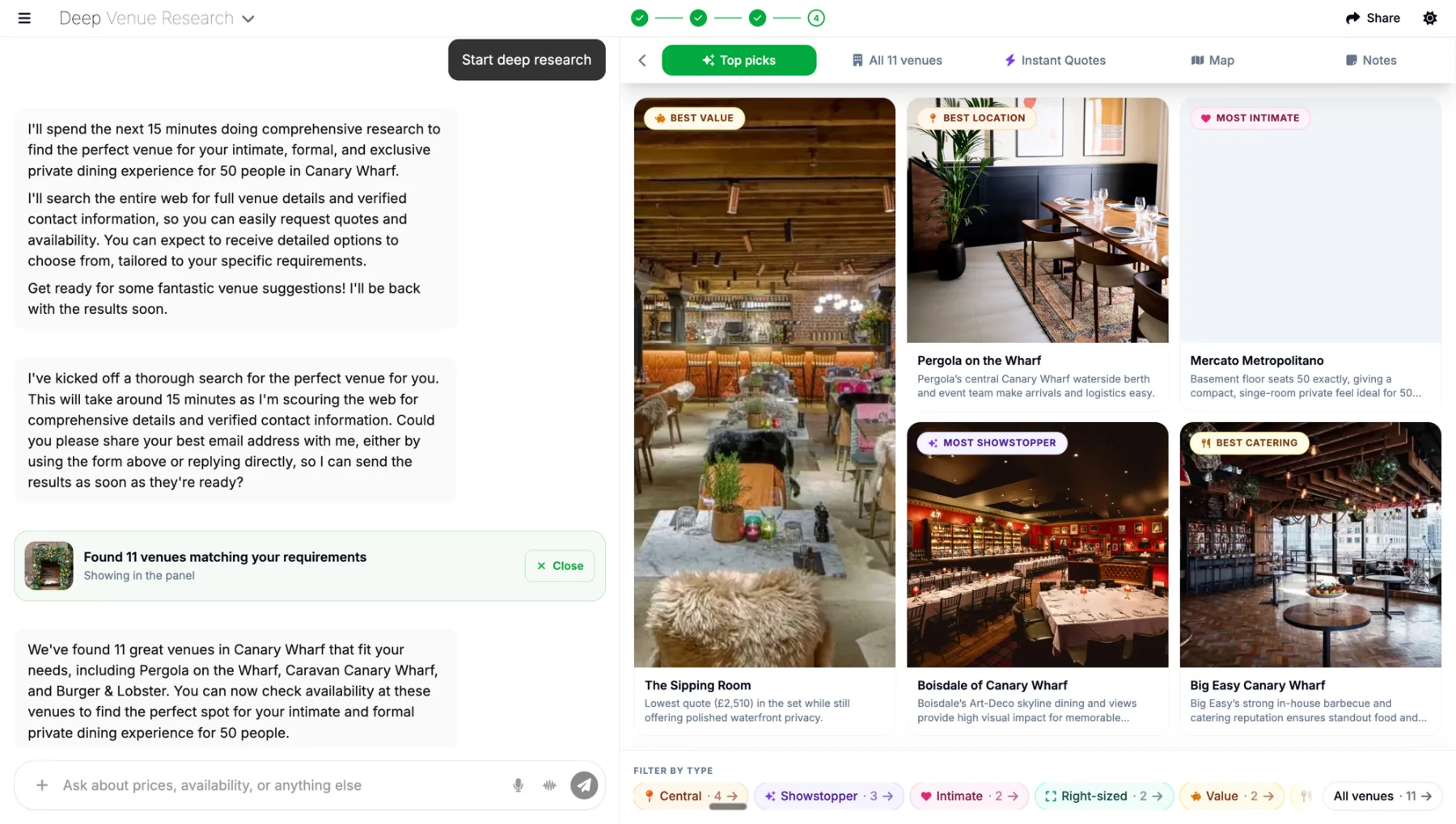
Real images of the space, because most venue decisions start with whether the room looks right.
Nothing reaches your list until we have confirmed the venue is trading and not shut for a refurbishment.
Estimates from the real quotes we hold, each one labelled with where it came from. If we are guessing, it says so.
180 seated is not 180 standing. We check capacity in the layout you want, and every deal-breaker you named.
Licensing hours for a late finish, catering for a dinner, step-free access when you asked for it. Not three screens of specification.
Best value, best location, hidden gem. One venue wins each label, in a sentence, and you can filter by it.
Thirteen ways to be the right answer. Your brief decides which of them matter.
FROM THE TEAMS USING IT
“Each recommended venue is thought through thoroughly, with great care and always has a personal touch.”

“I love the online portal. It is really easy to use and I love how I can share venue suggestions with event stakeholders, and that we can manage access across the organisation.”

“We have increased the number of events we do, and that has only been possible because of the time-saving elements that Hire Space provides. It has already saved us thousands of pounds booking venues all over the world.”

“For a recent client networking event at Emirates Stadium, I saved over 12 hours by avoiding the usual back-and-forth with venues over pricing, availability and contracts.”

FAQ
Yes, and it is the part other tools get wrong. Hotels never publish how many rooms they can give a group, so most tools guess. We read each hotel the way a revenue manager would: does it have the rooms on your dates, and is its rate that week below or above its usual. A hotel discounting on your dates wants your business. One priced high expects to sell out anyway.
If your event is mostly about rooms, the search flips round: we find the hotels most likely to say yes first, then build the event around them. It is a read from public signals, with the reasons shown, not a confirmed booking.
From the real quotes Hire Space holds, built up over years of booking these venues. Each estimate says what it is based on, so a figure from a venue's own quote history says exactly that, and one estimated from the market says that instead. It will never invent a number to look confident.
Both are normal here. A travel-time limit is timed by car and by public transport, whichever you would actually use, and treated as your intent rather than a stopwatch. A brief across several cities runs as separate legs, each with its own search, checks and shortlist, so a strong set of London options never hides a gap in Manchester.
You will be told. A sit-down dinner at £10 a head is not a research problem, it is an arithmetic one, and pretending otherwise wastes your week.
Ambitious is different from impossible, though. Tight budgets, awkward dates and unusual combinations still get researched properly, and those are exactly the briefs where checking every venue pays off.
With your permission, yes. It reads your company's past enquiries and bookings to learn the calibre and style you tend to book, and weighs that into the search. If your organisation always ends up in heritage buildings, or never approves anything above a certain rate, it stops being something you have to explain every time.
That is the bit most AI tools leave you to do alone. Enquire in one click with your brief attached, or hand the shortlist to the Hire Space team for qualifying business enquiries and we take it from there: contacting venues, chasing the ones that go quiet, negotiating, and running it through to the contract.
No, and that is the main difference. Other venue platforms can only show you what is in their own database. We search the open web, then build a verified profile for whatever we find, so a venue that has never listed with anyone is just as findable as one that has.
Yes. The briefs it has been benchmarked on span cities including New York, Singapore, Sydney, Edinburgh, Manchester and Austin, and a single brief can cover several of them at once.
Yes. Deep Venue Research is available as a connected app in both, so you can run a brief without leaving the conversation you are already having and get the same shortlist back.
The first part is immediate: a couple of questions, then three quick ideas so you can check it has understood you. The full research then runs in the background across a hundred or more venues, so it is not an instant answer, and it is not meant to be. It is the work you would otherwise spend days on.
Never. Nothing goes to a venue until you choose to send it. You decide whether to enquire yourself or hand it to our team, and you can do that for one venue on the list or all of them.
Yes. Hire Space holds two UK patents covering our work in the AI application layer, which is the part that turns a brief into verified, priced, actionable venue options rather than a list of names.
WHY YOU CAN TRUST IT
Three things go wrong with an AI venue list: the venue does not exist, it does not really fit, or the price is made up. We check for all three before you see it.
Every brief becomes 20 to 25 targeted searches across the open web, each run by its own agent. If a venue fits your brief it is findable, whether or not it has ever listed on a marketplace.
Recommending a venue that closed last year is how a shortlist loses the room. Every candidate has to pass an existence check before anything judges whether it fits.
Every surviving venue gets its own agent asking what you would ask: does it hold your numbers in your layout, does it clear every deal-breaker you named. On a typical brief that is a hundred or more venues, checked at once.
Estimates come from Hire Space's bank of real venue quotes, and every figure is labelled with its evidence. It never invents a number to look confident.
Hire Space holds two UK patents covering our work in the AI application layer, which is the part that turns a brief into verified, priced, actionable options rather than a list of names.
TESTED BY SOMEONE ELSE
VenueBench gave seven venue-finding tools the same twelve real briefs and had an independent judge mark the answers blind. See the full results →



Describe the event in plain English. Deep Venue Research finds, checks and prices the venues, and a human expert is on hand the moment you want one.